

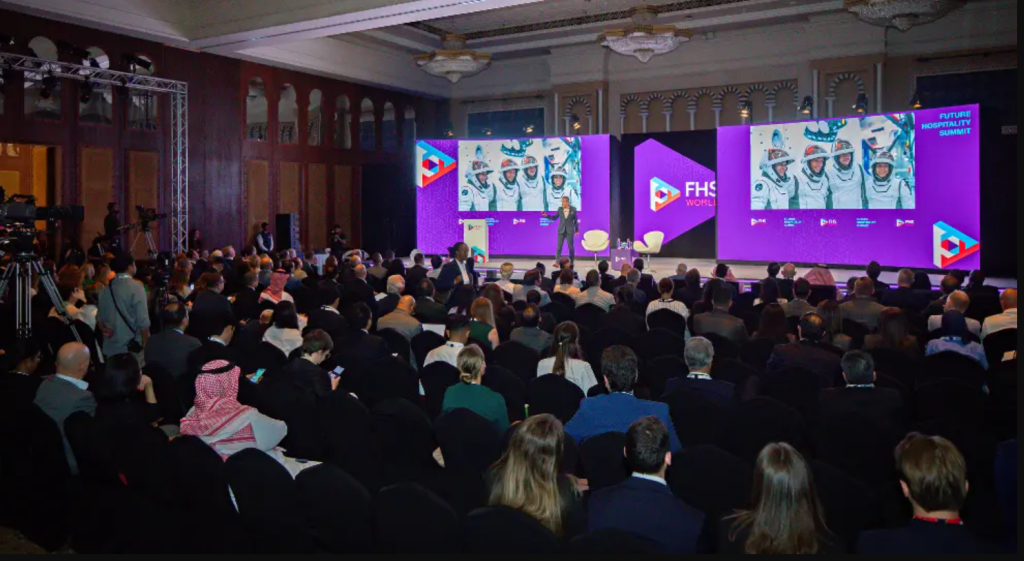
Hotel investors and operators are meeting in Dubai from 27–29 October for Future Hospitality Summit, a three-day forum at Madinat Jumeirah focused on hotel investment, deal flow and market outlooks across the Middle East, Europe, Asia and Africa.
Organisers expect more than 300 investors among 1,600+ delegates, underscoring Dubai’s position as a global hub for hospitality investment.
Capital shifts from caution to selectivity
Investor commentary ahead of the summit points to capital returning to hotels with tighter discipline. Delegates cite a clear preference for assets that demonstrate resilient cashflow, stronger operational performance and measurable progress on sustainability and governance.
Themes likely to dominate the Dubai agenda include tech-enabled operations, data-driven revenue management, and asset-light or mixed-use models that blend hotels with branded residences and retail—areas seen as more defensible in a high-cost development cycle.
Across the Gulf, decision-makers are focusing on location, operating efficiency and brand execution rather than headline-grabbing builds.
That approach reflects a broader recalibration in global hotel investment, where underwriting assumptions are being reset to reflect construction inflation, tighter financing and talent constraints in key growth markets.
Where the money is going: lifestyle, extended stay and branded residences
Deal pipelines suggest a tilt toward lifestyle hotels, extended-stay products and branded residences—segments that align with evolving travel patterns and diversify income beyond traditional room revenue.
Independent research shows the branded residence category remains in growth mode worldwide, with more than 1,000 live and pipeline schemes reviewed across 83 countries in 2025, and an expanding roster of hospitality and non-hospitality brands entering the space.
For developers and owners, fee income, loyalty integration and perceived price premiums continue to be central drivers. Knight Frank
Investors attending the Dubai hotel summit also flag wellness-led resorts and culturally rooted experiences as areas of interest, particularly in destinations building new demand through infrastructure and visa reform.
Extended-stay models are drawing attention for their operating margins and length-of-stay stability, while select-service and midscale lifestyle concepts are viewed as resilient options in markets where construction and fit-out costs are rising.
Market context: Dubai demand and gulf pipelines
The local backdrop is supportive. Dubai recorded 92.3 million passengers at Dubai International Airport in 2024—its highest ever—while a government-backed plan to expand Al Maktoum International (DWC) envisions capacity rising to as much as 260 million passengers in the coming years, with a new terminal budgeted at roughly $35 billion.
Officials plan to transition major operations to DWC over the next decade, reinforcing the city’s long-term air connectivity and hotel demand fundamentals.
Tourism performance has continued to firm in 2025: Dubai welcomed 12.54 million overnight visitors in January–August, up around 5% year-on-year, keeping the emirate on track as one of the world’s busiest travel markets.
Such demand supports new room supply while encouraging capital towards conversions, limited-service developments and phased mixed-use schemes that better match cashflow with delivery risk.
Saudi Arabia’s investment narrative remains a major talking point in Dubai. The Kingdom has lifted its target to 150 million visitors by 2030 under Vision 2030, a policy backdrop that continues to draw regional and international capital into coastal resorts, urban lifestyle hotels and extended-stay products.
For many investors, that scale objective—paired with public-sector infrastructure spending—underpins a multi-year pipeline across the wider Gulf.
What to watch: hospitality investment outlook into 2026
For the next 12–18 months, participants at the Dubai hotel summit will be tracking three pressure points: build costs, financing and talent.
Higher construction and fit-out prices are prompting phased delivery and more selective underwriting; tighter debt availability is pushing sponsors to structure deals with a broader mix of equity partners; and labour availability is shaping brand and operator choice in new projects.
At the same time, disclosure on ESG is becoming a routine requirement in hotel transactions, with investors seeking third-party certification, credible energy-efficiency plans and data that link capex to operating savings.
With liquidity returning, the market signal from Dubai is pragmatic rather than exuberant: pursue hotel investment where the demand story is hard-wired by air capacity and policy, favour operational flexibility over speculation, and prioritise assets that can prove performance through cycles.
That is the lens many global investors will apply as they assess opportunities presented on the floor at Madinat Jumeirah this week.